

Micro Batching Whiskey Is Now Common. We Created the Category Decades Ago
- Liz Provencher
- 2 hours ago
- 4 min read
"Our whiskey is far less than a small batch. It's a true micro batch." Marci Palatella coined the term in the Eighties. The philosophy hasn't changed since.
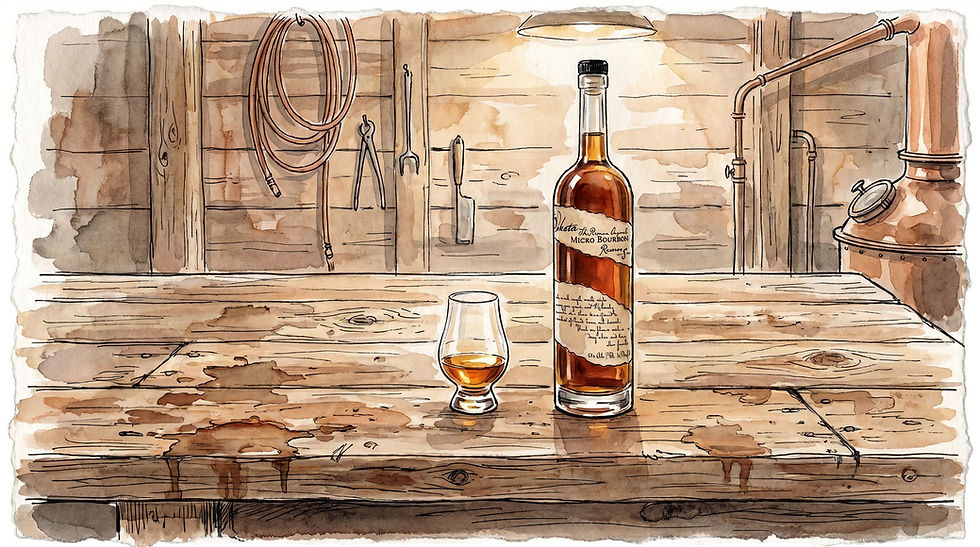
Walk down the aisle of any liquor store and scan the bottles, and you’ll find no shortage of labels touting the distillery’s small production. Phrases like small batch or small lot appear on labels all the time today, though there’s no official industry designation for “small batch,” which can sometimes be 300 to 1,000 barrels at a time.
But long before these terms became buzzwords, we at Preservation Distillery coined a far truer one: micro batching. It’s just what it sounds like: we produce micro batches, of one to three barrels at a time.
Initially, it was simply a function of how we made our very first releases: when you don’t have the money to produce large quantities, you make really small ones. That’s how our founder Marci Palatella operated when starting out more than three decades ago.
And then we coincidentally discovered how that process of super small production, the smallest of batches, can result in incredible quality, with consistently unique flavor profiles. We believe that controlled, micro batches made with careful blending and hands-on craftsmanship is what elevates bourbon from good to great. For us, that approach wasn’t a pivot or a marketing decision, it was our founding principle and has continued to guide our production for decades.
Shooting for scale and consistency has long been the industry’s marker for success, but we chose to work in deliberately limited batches to prioritize flavor, control, and character over volume. (Palatella is fond of saying, “What we’re doing here is all done with intention.”) When we say limited batch, we mean it. Every bottle of whiskey crafted at Preservation Distillery is made in one- to three-barrel batches, ensuring that our master of maturation has control to select the barrels that will make a big, rich, and bold whiskey that Palatella became known for long ago.
How Marci Palatella Coined the Term "Micro-Batch" in the Eighties
This philosophy goes back to the start, before founder Palatella even opened Preservation Distillery in Bardstown, Kentucky. One of the earliest bottles Palatella created was Dakota Micro Batch in the late Eighties, the first whiskey to display the words “micro batch” on a bottle. “Nobody cared much about what I was doing so it didn’t exactly make a big splash,” she jokes, but coining the term proves to have been a quiet but defining moment for the category.
For Palatella, the decision to start calling her liquid micro batched was rooted in a desire for defining and displaying what she was releasing. And out of frustration that the terminology for defining production scale was too broad. “At that time, Jim Beam was trying to trademark ‘small batch,’ and I remember thinking, ‘Well, ours is beyond small batch. It’s a micro batch, so that’s what I’m going to call it.”
With Dakota Micro Batch and the rest of Preservation Distillery’s slate over the decades, Palatella has created more than 300 products centered on sourcing, distilling, and micro batching, committing to using a maximum of three barrels for nearly every expression. With such rigorous standards for how bourbon gets into the bottle, Palatella didn’t want to blend in with other products. She wanted to showcase just how small the production really was.
How Preservation Distillery's Micro-Batch Process Actually Works Today
Thanks to Palatella’s background in distribution and deep relationships after decades in the industry, Preservation has several thousand barrels all aging in its barrel house; some proprietary pot distillate made by the brand as well as a small number of exceptional barrels acquired over many years. The micro batching process is the single most precise way to combine these stocks, while balancing and accentuating flavors, says general manager Kyle Lloyd.
For each new expression, Lloyd and his production team meticulously sort and sample through barrels to find the best available. After selecting, and then tasting with Palatella, they repeatedly try micro batch blends to ensure they’re the right fit for the distillery’s big, bold flavor profile.
Pulling off a micro production like this demands incredible attention to detail, Lloyd adds. “To execute a really good batch that is so tiny, we have to be very hands-on at every step in the process,” Lloyd says. “Tasting every barrel, tasting how things commingle after they're put together, following the maturation of each barrel. There's quite a process to validate that.”
The vast catalog of small lots of unique vintage barrels and house-made products means the team has options to experiment with what most distilleries aren’t allotted, and likely never had access to. It also makes Lloyd’s approach to micro batching a real artistic process, allowing the team to tinker with results and create nuances in the liquid that often gets flattened at a larger scale.
That level of craftsmanship is hard to match using any other approach. “We're leaning on our nose and palate and a specific feel to create those things,” Lloyd says. It’s a process that prioritizes variation over uniformity and means each lot will have different characteristics. “What we do here is not for everyone. Someone that is looking at the artistic aspect of bourbon is going to appreciate the small nuances from each bottle, each micro batch,” he says. For Palatella and the Preservation Distillery team, those tiny variances, the “flavor bombs” as she calls them, are when the real character of the bourbon shows up.
Even now that micro batching has entered the industry’s shared vocabulary, the majority of companies still aim to scale up and grow, but not us. At Preservation Distillery, we are committed to our ultra small, high-touch production to create the finest bourbon. Would we like to grow a little more? Of course, but not at the expense of quality. For us, micro batching was never just a flashy marketing term, it’s always been a process that creates the stuff we want to drink.
Comments